
Call Us Any Time
+86-379-60689957
Call Us Any Time
+86-379-60689957
Within the long-term operational framework of wind turbine generators, slewing bearings not only fulfill the core function of nacelle yaw control but also directly influence the load transfer pathways and structural stability of the entire machine. Many wind projects experience abnormal noises during yaw, excessive gear ring wear, or even structural loosening after 5–8 years of operation. The root cause is often not material failure, but rather a lack of systematic lubrication management planning. For wind turbine manufacturers and maintenance providers, establishing a scientific and actionable lubrication and maintenance system for slewing bearings has become a critical means to extend unit lifespan and control total lifecycle costs.
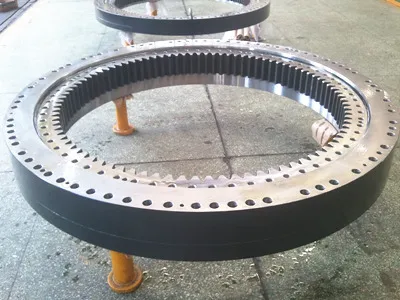
Wind turbines operate continuously under low-speed, heavy-load conditions. The yaw system endures sustained wind load impacts during directional adjustments, while the pitch system requires high-precision responses through frequent micro-adjustments. Due to low rotational speeds, forming an ideal fluid lubrication film between raceways and rolling elements is challenging, leaving equipment prone to boundary lubrication or even dry friction.
When deployed in offshore wind farms, high levels of salt fog accelerate metal corrosion. In frigid regions, lubricating grease exhibits increased viscosity or even hardening at low temperatures. In high-wind-speed zones, yaw operation frequency significantly increases. The cumulative effects of these operating conditions can lead to a cascade of issues—including raceway pitting, gear surface spalling, and rolling element fatigue cracks—if the lubrication system lacks targeted design.
Therefore, lubrication management for wind turbine slewing bearings is not merely “periodic grease replenishment,” but a systematic engineering approach integrating operating conditions, environmental factors, and operational data.
Many projects initially install grease according to manufacturer recommendations during equipment commissioning. However, as the operating environment evolves, lubrication strategies often fail to undergo corresponding optimization. In reality, wind farms in different regions exhibit significant variations in grease performance requirements.
For coastal or offshore wind farms, maintenance teams must select greases with superior water washout resistance and salt spray corrosion protection. Such greases typically require high adhesion and potent extreme pressure anti-wear additives to ensure stable retention on raceways and gear surfaces in high-humidity environments.
For projects in frigid regions, maintenance personnel should prioritize synthetic-based greases with excellent low-temperature fluidity. Conventional mineral-based greases tend to harden in cold conditions, compromising lubrication effectiveness and increasing startup torque.
In high-temperature areas or environments where summer temperatures consistently exceed 40°C, grease oxidation stability and drop point specifications must meet higher standards. Failure to do so risks grease separation, leading to oil film breakdown and accelerated metal-to-metal wear.
Scientific grease selection should be based on a comprehensive assessment of the project's climate conditions, annual operating hours, and yaw frequency, rather than relying solely on a uniform specification.
In practical operations, many companies still employ fixed-interval grease replenishment, such as uniform lubrication every six months. However, operational loads vary significantly across different wind farms. Without dynamic adjustments based on data, situations of insufficient lubrication or over-lubrication may arise.
When units experience high yaw frequencies or abrupt wind direction changes, grease consumption accelerates markedly. In such cases, maintenance teams should shorten inspection cycles and assess internal wear by observing the color and condition of drained old grease.
When unit operation is relatively stable, maintenance personnel may moderately extend lubrication intervals, but regular seal inspections and vibration monitoring remain essential. A scientific lubrication strategy should be grounded in vibration trend analysis, temperature variation records, and lubricant sampling tests.
Many premature failures in slewing bearings stem not from substandard lubricant quality, but from improper lubrication techniques.
During lubrication, the unit should be rotating at low speed to facilitate even grease distribution within the raceway. Injecting large quantities of grease at once while stationary can cause localized buildup, leading to pressure concentration and seal damage.
After replenishment, operators must allow the unit to complete at least one full rotation and promptly clean any external grease overflow. Residual grease left on the gear ring and seal periphery for extended periods attracts dust and grit, accelerating external wear.
Proper grease replenishment not only extends the effective service life of the lubricant but also significantly reduces the risk of seal system damage.
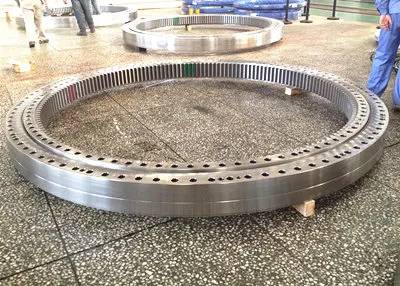
Some operations and maintenance teams often focus their attention on internal raceway lubrication while neglecting the maintenance of exposed gear rings. In fact, gear rings directly participate in yaw drive meshing, and their wear rate often exceeds that of internal raceway structures.
Insufficient tooth surface lubrication can cause stress concentration at the tooth root, eventually forming microcracks that propagate over time. Gear ring lubrication should use specialized gear grease, with visual inspections confirming uniform tooth surface contact.
If maintenance personnel detect abnormal wear particles or uneven meshing during inspections, they should promptly investigate the condition of the yaw drive motor and reducer, rather than merely replenishing grease.
The slewing bearing seal structure plays a critical role in isolating moisture and dust. When seals exhibit aging, cracking, or localized deformation, contaminants can infiltrate the raceway. Even with high-quality internal grease, once impurities enter, they rapidly cause abrasive wear.
Maintenance personnel should conduct comprehensive inspections of the seal structure during each grease replenishment or annual maintenance, documenting wear conditions. For offshore wind projects, seal inspection frequency should be significantly higher than for onshore projects.
With the advancement of smart maintenance technologies, an increasing number of wind farms are deploying vibration sensors and temperature monitoring systems. By analyzing trend data from slewing bearing operations, maintenance teams can detect abnormal changes in advance.
When abnormal vibration peaks occur, technicians can confirm increased metal particles through grease sampling analysis. Persistent temperature rises indicate insufficient internal lubrication or abnormal meshing.
Data-driven maintenance effectively prevents over-servicing or delayed repairs caused by human judgment errors.
Wind power projects typically have investment cycles exceeding twenty years. As a critical load-bearing component, the health status of slewing bearings directly impacts overall operational safety and power generation revenue. Companies that prioritize lubrication maintenance accessibility during equipment design, establish standardized grease replenishment procedures during operation, and dynamically optimize based on environmental factors and data can significantly extend equipment lifespan.
For wind turbine manufacturers, delivering systematic slewing bearing lubrication solutions not only enhances product reliability but also strengthens long-term customer loyalty. In an increasingly competitive wind power market, true professional capability is demonstrated not by individual component specifications, but by a comprehensive technical service system built around the entire equipment lifecycle.
Whether your project involves planning new turbine installations or existing units have entered mid-life operations, implementing a scientific lubrication and maintenance management plan for slewing bearings will serve as a critical safeguard for reducing risks and maximizing returns.
Comprehensive Guide to Cleaning and Re-Greasing Thin Section Bearings for Long-Term Reliability
2026-03-24 11:23Understanding and Preventing Premature Failure in Thin Section Ball Bearings: A Practical Engineering Perspective
2026-03-18 20:29The Engineering Dilemma: Stainless Steel vs. Chrome Steel for Thin Section Bearings in Corrosive Environments
2026-03-11 13:02Optimizing Thin Section Bearing Torque for High-Speed Applications: Advanced Engineering Insights
2026-03-05 13:35Address: Lianmeng Road, Jianxi district, Luoyang City,Henan province.
E-mail: info@lynicebearing.com
Phone: +86-379-60689957
If you are interested in our products and services,
please feel free to contact us!
Get in tuch

+86-379-60689957
Lianmeng Road, Jianxi district, Luoyang City,Henan province.